


Characteristics
| Molecular Formula | C14H21N6O4 |
| CAS Number | 89030-95-5 |
| Molar Mass | 404.9 g/mol |
| Chemical Formula | C14H21CuN6O4 |
| Amino Acid Sequence | Gly-His-Lys |
| Synonyms | Copper tripeptide-1, Copper-GHK, GHK-Cu, Copper peptide |
| Solubility | Water-soluble |
| Organoleptic Profile | Blue powder |
| Composition | Lyophilized powder - requires reconstitution |
How does GHK-Cu work?
GHK-Cu exerts its effects through multiple mechanisms of action. The peptide complex has been shown to stimulate collagen synthesis, promote angiogenesis (the formation of new blood vessels), and enhance the proliferation and survival of skin cells, such as fibroblasts and keratinocytes. GHK-Cu also exhibits antioxidant and anti-inflammatory properties, which contribute to its wound healing and tissue repair capabilities.
At the molecular level, GHK-Cu can modulate the expression of numerous genes involved in skin repair, extracellular matrix remodeling, and inflammation. The peptide complex has been found to upregulate the expression of matrix metalloproteinases (MMPs), which are enzymes responsible for the degradation of damaged collagen and elastin fibers, allowing for the deposition of new, healthy extracellular matrix components.
Furthermore, GHK-Cu has been shown to chelate copper ions, which are essential for the proper functioning of enzymes involved in collagen synthesis and cross-linking, such as lysyl oxidase. By delivering copper ions to the skin, GHK-Cu can enhance the activity of these enzymes, leading to improved skin firmness and elasticity.
Benefits
- Skin rejuvenation: GHK-Cu has been extensively studied for its potential in skin rejuvenation and anti-aging applications. The peptide complex has been shown to stimulate collagen synthesis, improve skin elasticity, and reduce the appearance of fine lines and wrinkles.
- Wound healing: GHK-Cu has demonstrated remarkable wound healing properties, promoting the closure of both acute and chronic wounds. The peptide complex stimulates the migration and proliferation of skin cells, enhances angiogenesis, and modulates inflammation, all of which contribute to faster and more efficient wound healing.
- Antioxidant and anti-inflammatory effects: GHK-Cu exhibits potent antioxidant and anti-inflammatory properties, which can help protect the skin from oxidative stress and reduce inflammation associated with various skin conditions, such as acne, rosacea, and psoriasis.
- Hair growth: Recent studies have suggested that GHK-Cu may promote hair growth and prevent hair loss. The peptide complex has been shown to stimulate the proliferation of hair follicle cells and prolong the anagen (growth) phase of the hair cycle.
- Neuroprotection: GHK-Cu has been investigated for its potential neuroprotective effects, particularly in the context of neurodegenerative diseases such as Alzheimer's and Parkinson's. The peptide complex has been shown to reduce oxidative stress and inflammation in the brain, and may help to prevent the accumulation of toxic protein aggregates.
Side Effects
Based on the available preclinical data, the most common side effects associated with GHK-Cu treatment include:
- Skin irritation: In rare cases, topical application of GHK-Cu may cause mild skin irritation, redness, or itching.
- Allergic reactions: Some individuals may be allergic to copper or the peptide components of GHK-Cu, which could lead to allergic reactions, such as rash, hives, or difficulty breathing.
- Interactions with other substances: GHK-Cu may interact with other medications or supplements, particularly those that affect copper metabolism or have antioxidant properties. Researchers should exercise caution when combining GHK-Cu with other substances.
Note: The safety profile of GHK-Cu has not been fully established, and further clinical studies are needed to fully evaluate the potential for side effects and long-term safety of GHK-Cu in mammals.
Summary
GHK-Cu is a naturally occurring peptide complex with a wide range of potential therapeutic applications, particularly in the fields of dermatology, regenerative medicine, and anti-aging research. The peptide complex has been shown to stimulate collagen synthesis, promote wound healing, and exhibit antioxidant and anti-inflammatory properties. Additionally, GHK-Cu has demonstrated promise in promoting hair growth and providing neuroprotection in the context of neurodegenerative diseases.
While GHK-Cu is generally considered safe and well-tolerated in research settings, more studies are needed to fully understand its long-term effects and potential side effects. As with any research material, proper precautions and guidelines should be followed when handling and using GHK-Cu.
As the scientific community continues to investigate the therapeutic potential of GHK-Cu, this peptide complex may emerge as a valuable tool in the development of new treatments for a variety of skin conditions, wound healing applications, and age-related disorders.
References
- Wang Y, et al. Rigid-flexible nanocarriers loaded with active peptides for antioxidant and anti-inflammatory applications in skin. Colloids Surf B Biointerfaces. 2024.
- Rakhmetova KK, et al. Effects of Gly-His-Lys-D-Ala Peptide on Skin Wound Regeneration Processes. Bull Exp Biol Med. 2024.
- Tucker M, et al. Behavioral and neuropathological features of Alzheimer's disease are attenuated in 5xFAD mice treated with intranasal GHK peptide. biorXiv [Preprint]. 2023.
- Liu T, et al. Thermodynamically stable ionic liquid microemulsions pioneer pathways for topical delivery and peptide application. Bioact Mater. 2023.
- Tucker M, et al. Intranasal GHK peptide enhances resilience to cognitive decline in aging mice. biorXiv [Preprint]. 2023.
- Zhang Q, et al. Relief of ovalbumin-induced airway remodeling by the glycyl-l-histidyl-l-lysine-Cu2+ tripeptide complex via activation of SIRT1 in airway epithelial cells. Biomed Pharmacother. 2023.
- Ren Z, et al. Multi working mode SPR chip laboratory for high refractive index detection. Opt Express. 2023.
- Wang F, et al. Improved laccase production by Trametes versicolor using Copper-Glycyl-L-Histidyl-L-Lysine as a novel and high-efficient inducer. Front Bioeng Biotechnol. 2023.
- Jiang F, et al. Synergy of GHK-Cu and hyaluronic acid on collagen IV upregulation via fibroblast and ex-vivo skin tests. J Cosmet Dermatol. 2023.
- Deng M, et al. Glycyl-l-histidyl-l-lysine-Cu2+ rescues cigarette smoking-induced skeletal muscle dysfunction via a sirtuin 1-dependent pathway. J Cachexia Sarcopenia Muscle. 2023.
Certificate of Analysis (COA)
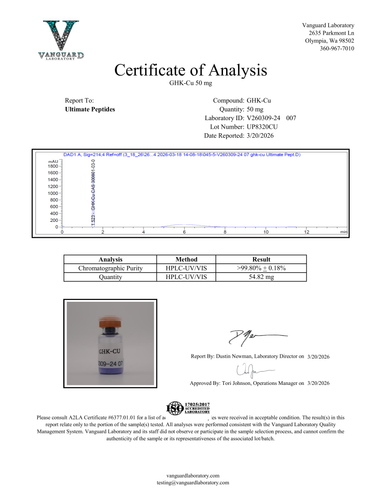
Click to enlarge
Resource
All products on this site are for research and development use only. Products are not for human consumption of any kind. The statements made on this website have not been evaluated by the US Food and Drug Administration. Neither the products described nor the company are intended to diagnose, treat, cure, or prevent any disease.
Research Peptides Supported by Verifiable Testing
Ultimate Peptides™ is more than just a U.S. supplier of research peptides. We are helping to power the next wave of peptide research, dedicated to providing peptides that support our clients' work.
Consistent Quality Standards
Our internal processes and meticulous sourcing of premium materials help every peptide we offer meet rigorous internal quality standards.
Independently Verified
Every product undergoes extensive testing, both in-house and through independent, third-party laboratories.
Fast Shipping & Support
We provide fast and reliable shipping, using established couriers and high-quality packaging materials to help ensure that your peptides arrive promptly and in optimal condition.