


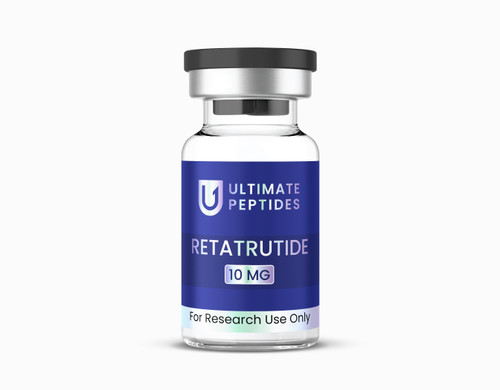
Product Specifications
| Molecular Formula | C221H342N46O68 |
| CAS Number | 2381089-83-2 |
| Molar Mass | 4191.7 g/mol |
| Amino Acid Sequence | His-Gly-Glu-Gly-Thr-Phe-Thr-Ser-Asp-Val-Ser-Ser-Tyr-Leu-Glu-Gly-Gln-Ala-Ala-Lys-Glu-Phe-Ile-Ala-Trp-Leu-Val-Lys-Gly-Arg |
| Synonyms | Reta acetate, LY3437943, GLP-1 receptor agonist |
| Solubility | Water-soluble |
| Organoleptic Profile | White to off-white powder |
| Composition | Lyophilized powder - requires reconstitution |
How does Retatrutide work?
Retatrutide is a GLP-1 receptor agonist that mimics the effects of native GLP-1, a hormone secreted by the intestinal L-cells in response to nutrient ingestion. By binding to and activating the GLP-1 receptor, Reta stimulates insulin secretion from pancreatic beta-cells in a glucose-dependent manner, while simultaneously inhibiting glucagon secretion from pancreatic alpha-cells. This dual action helps to regulate blood glucose levels and improve glucose homeostasis. In addition to its effects on glucose metabolism, Reta also promotes satiety and reduces food intake by acting on GLP-1 receptors in the hypothalamus, a key region of the brain involved in appetite regulation. By increasing feelings of fullness and reducing hunger, Reta can lead to significant weight loss when combined with a calorie-controlled diet and exercise.
Furthermore, Reta has been shown to exert anti-inflammatory effects by modulating immune cell function and reducing the production of pro-inflammatory cytokines. This anti-inflammatory action may contribute to its beneficial effects on metabolic health, as chronic low-grade inflammation is a hallmark of obesity and related disorders.
Benefits
- Significant weight loss: Reta has demonstrated the ability to promote substantial weight loss in preclinical studies, making it a promising candidate for the treatment of obesity.
- Improved glucose homeostasis: By enhancing insulin secretion and inhibiting glucagon secretion, Reta helps to regulate blood glucose levels and improve glucose tolerance, which is particularly beneficial for individuals with type 2 diabetes.
- Reduced inflammation: The anti-inflammatory properties of Reta may help to mitigate the chronic low-grade inflammation associated with obesity, thereby reducing the risk of developing obesity-related comorbidities.
- Enhanced stability and half-life: Reta has been engineered to exhibit improved stability and a prolonged half-life compared to native GLP-1, allowing for less frequent dosing and potentially improving patient compliance.
- Targeted approach to metabolic health: By selectively targeting the GLP-1 receptor, Reta offers a targeted approach to managing obesity and related metabolic disorders, minimizing the risk of off-target effects.
Side Effects
Based on the available preclinical data, the most common side effects associated with Reta treatment include:
- Gastrointestinal symptoms: Nausea, vomiting, and diarrhea have been reported in some studies, although these side effects are generally mild and transient.
- Injection site reactions: Local reactions at the injection site, such as redness, swelling, and itching, may occur in some individuals.
- Hypoglycemia: In rare cases, Reta may cause low blood sugar levels, particularly when used in combination with other glucose-lowering medications.
Note: The safety profile of Reta has not been fully established, and further clinical studies are needed to fully evaluate the potential for side effects and long-term safety of Reta in mammals.
Summary
Reta is a promising novel peptide that targets the GLP-1 receptor for the treatment of obesity and related metabolic disorders. By mimicking the effects of native GLP-1, Reta promotes weight loss, improves glucose homeostasis, and reduces inflammation. Its enhanced stability and prolonged half-life offer the potential for less frequent dosing and improved patient compliance. While preclinical studies have shown encouraging results, further clinical trials are needed to fully evaluate the potential for the safety and efficacy of Reta in mammals. As a targeted approach to managing obesity and its associated comorbidities, Reta holds promise as a future therapeutic option for individuals struggling with weight management.
References
- Jastreboff AM, Kaplan LM, Frias JP, Wu Q, Du Y, Gurbuz S, Coskun T, Haupt A, Milicevic Z, Hartman ML; Reta Phase 2 Obesity Trial Investigators. Triple-Hormone-Receptor Agonist Reta for Obesity - A Phase 2 Trial. N Engl J Med. 2023.
- Rosenstock J, Frias J, Jastreboff AM, Du Y, Lou J, Gurbuz S, Thomas MK, Hartman ML, Haupt A, Milicevic Z, Coskun T. Reta, a GIP, GLP-1 and glucagon receptor agonist, for people with type 2 diabetes: a randomised, double-blind, placebo and active-controlled, parallel-group, phase 2 trial conducted in the USA. Lancet. 2023.
- Doggrell SA. Reta showing promise in obesity (and type 2 diabetes). Expert Opin Investig Drugs. 2023.
- Doggrell SA. Is reta (LY3437943), a GLP-1, GIP, and glucagon receptor agonist, a step forward in the treatment of diabetes and obesity? Expert Opin Investig Drugs. 2023.
- Harris E. Triple-Hormone Combination Reta Induces 24% Body Weight Loss. JAMA. 2023.
- Urva S, O'Farrell L, Du Y, Loh MT, Hemmingway A, Qu H, Alsina-Fernandez A, Haupt A, Milicevic Z, Coskun T. The novel GIP, GLP-1 and glucagon receptor agonist reta delays gastric emptying. Diabetes Obes Metab. 2023.
- Elfeki MA, Alkhouri N. Triple-Hormone-Receptor Agonist Reta for Obesity. N Engl J Med. 2023.
- Jastreboff AM, Kaplan LM, Hartman ML. Triple-Hormone-Receptor Agonist Reta for Obesity. Reply. N Engl J Med. 2023.
- Ray A. Reta: a triple incretin receptor agonist for obesity management. Expert Opin Investig Drugs. 2023.
- Bisson A, Fauchier G, Fauchier L. Triple-Hormone-Receptor Agonist Reta for Obesity. N Engl J Med. 2023.
- Sidik S. Beyond Ozempic: brand-new obesity drugs will be cheaper and more effective. Nature. 2023.
- Naeem M, Imran L, Banatwala UESS. Unleashing the power of reta: A possible triumph over obesity and overweight. A correspondence. Health Sci Rep. 2024.
- Hong SH, Choi KM. Gut hormones and appetite regulation. Curr Opin Endocrinol Diabetes Obes. 2024.
For research use only. Not for human consumption.